
A Texas Workers’ Compensation Update from Downs & Stanford, P.C.
In the ever-evolving Texas Workers’ Compensation system, staying ahead of developments can make all the difference. Each month, our experienced attorneys highlight the key decisions, regulatory updates, and emerging trends that matter most to claims professionals, helping you manage risk, control costs, and navigate claims with confidence.

We are excited to bring back our monthly Lunch & Learn program designed to help you stay current on key industry topics while earning continuing education (CE) credit. Each session delivers practical insights you can apply immediately, and you will walk away with CE credit for your participation.
The first 25 adjusters to sign up will be in the course. Once you have registered, you will receive confirmation for the Webinar. The Zoom link will be emailed the Monday before each Webinar. Please note that if you have taken the course before in the last two years, you will not be eligible for credit again per 28 Texas Administrative Code Section 19.1010(7)(c).
Join us on May 8, 2026, from 12:00 P.M. to 1:00 P.M. to discuss: Legal Defenses with John V. Fundis and D. Rynn Freiling.

Your monthly look at the goings on with DWC, and how it impacts Carriers
Potential Changes to Return-to-Work Guidelines
On May 6, 2026, DWC issued a memo concerning potential amendments to return to work guidelines. As many of you are aware, the Texas Workers’ Compensation system requires the use of disability duration values in the adopted return to work guidelines, and Designated Doctors are required to subscribe to those guidelines.
For years, this has been through the MDGuidelines. However, MDGuidelines is expected to substantially increase its rates this fall, and as a result, the decision has been made to move to the Official Disability Guidelines (ODG) for disability determinations.
As Carriers and doctors already use the ODG for treatment guidelines, this will allow system participants to avoid the extra cost associated with using MDGuidelines.
If adopted, Rule 137.10 will be amended to reflect this change.
Medical Quality Review Audit Plan Finalized
DWC has also finalized their 2026 Medical Quality Review audit plan, and it is going to focus solely on the medical necessity and appropriateness of prescribing topical analgesics to Claimants.
While the prescribing of these medications is something that is relatively rare in the workers’ compensation system, there have been multiple federal indictments and convictions of health care providers who defrauded the federal workers’ compensation system with systematic prescriptions of these compounds.
Typically, these are prescriptions that require pre-authorization, which is why we don’t see it as much in the Texas system.
Designated Doctor Program Overview
Finally, DWC issued their overview of the state of the Designated Doctor (DD) program in Texas in April.
Not surprisingly, the total number of DDs decreased from 2020 to 2024.
In 2024, there were a total of 304 DDs, and there were 27,866 DD appointments.
In 2024, 7% of DD MMI/IR determinations were disputed, and approximately 80% of those ratings were upheld.
It is interesting to note, however, that this report does not appear to address disputes of DDs regarding extent of injury, where disputes are much more successful.
In 2024, there were approximately 850 Letters of Clarification sent to DDs via DWC, but no information was presented regarding the number of Presiding Officer’s Directives (PODs) to these doctors during this time frame.
Final Thoughts
As always, these developments provide useful insight into where DWC’s focus may be heading in the coming months. From the potential shift to ODG, to increased scrutiny on topical analgesic prescribing practices, and the continuing evolution of the DD program, Carriers should continue monitoring these areas closely as additional guidance and rule changes develop.
Author: R. Christopher Esson

Here are the highlights, the lowlights, and the “well, that’s interesting” moments from recent Texas Workers’ Compensation Decisions.
APD 260490
DECISION:
The parties modified the issue at the CCH to “Does the compensable injury of (date of injury), extend to an L5-S1 disc protrusion/herniation?” But then the ALJ failed to include the L5-S1 disc herniation in the issue statement, make findings of fact or conclusions of law, or enter a decision on whether the compensable injury extends to an L5-S1 disc “herniation”. The case was remanded for the ALJ to make such determinations.
💡 WHAT THIS MEANS FOR YOU:
Easy to modify the issues at a CCH; harder to remember to change the CCH template.
Tex. Ass’n of Cntys. Risk Mgmt. Pool v. Adams
2026 Tex. App. LEXIS 4313 (Tex. App.—Beaumont May 7, 2026, no pet. h)
DECISION:
Deputy Constable Adams, the decedent, was shot and killed while working in his second job as a private security guard at a mall. A store in the mall called the decedent when a customer became irate because his credit card was declined. A scuffle ensued and the customer grabbed the decedent’s gun and shot and killed him.
DWC determined the decedent was not in the course and scope of San Jacinto County while working at the mall as a security officer. The beneficiary, the decedent’s wife, filed a judicial review lawsuit against the risk pool (TAC), not the actual self-insured employer, San Jacinto County.
The beneficiary also filed for declaratory relief asking the trial court to declare peace officers are in the course and scope of their employment with governmental entities when injured during their employment as a private security guard.
The trial court ruled for the beneficiary. TAC filed an interlocutory appeal challenging the trial court’s denial of a plea to the jurisdiction and granting the beneficiary’s Summary Judgment on the declaratory relief finding that an officer injured while working a second job was injured while working for the governmental agency, among other things.
The court holds that TAC, as an interlocal governmental risk pool, is not the workers’ compensation carrier; San Jacinto County is the employer that chose to self-insure through a risk pool and is thus considered the workers’ compensation carrier. Such risk pools enjoy governmental immunity unless waived.
The court found the beneficiary was not challenging the validity of the statutes, just a declaration of her rights under the statutes. But the Uniform Declaratory Judgement Act’s limited waiver of governmental immunity does not apply in this context. Therefore, the trial court should have granted the plea to the jurisdiction regarding the declaratory relief.
💡 WHAT THIS MEANS FOR YOU:
The risk pool is not a workers’ compensation carrier and enjoys governmental immunity, unless waived. A declaratory action is not the proper mechanism to challenge DWC’s decision.
Author: Stuart D. Colburn

Timely Payment of Income Benefits
It is a violation for a carrier to not pay income benefits weekly, as and when the benefits accrue. This includes impairment income benefits (IIBS).
An insurance carrier must pay IIBS no later than five days after the carrier receives the doctor’s report certifying maximum medical improvement (MMI) when the MMI is not disputed.
Failing to timely pay accrued income benefits within five days of receiving the certifying doctor’s report is a violation of Rule 130.8.
Compliance and Investigations will issue a monetary penalty if IIBS are not paid timely and weekly as and when due.
In addition, any late payment of income benefits shall be paid with interest in a lump sum.
A violation occurs each time a carrier fails to timely pay interest with accrued but unpaid income benefits.
Be careful:
Compliance and Investigations are treating these types of violations seriously with monetary violations in the thousands of dollars.
Author: John V. Fundis

What is a POD, what to do with the POD, and how to best utilize the POD.
DWC states the POD and Letters of Clarification (LOC) are ways of communicating with designated doctors.
A POD is necessary when new information needs to be presented to the designated doctor, usually concerning extent of injury issues, and the designated doctor is asked to consider new information that was not previously available at the time of the designated doctor’s appointment. New information, such as extent of injury issues, posed to the designated doctor will necessitate a new examination by the designated doctor, which is a billable action for the designated doctor.
An LOC is necessary when a clarification or correction is needed from a designated doctor regarding questions that have arisen from the designated doctor’s report. The LOC does not result in another examination by the designated doctor. The LOC response from the designated doctor is not a billable action for the designated doctor. Thus, LOCs should be used sparingly and only in specific instances.
When Are PODs Necessary?
PODs are a DWC creation and are necessary when:
- Administrative Law Judges (ALJs) need specific reports from a designated doctor in order to resolve a dispute;
- There is a need for an opinion from the designated doctor in order to reduce delays in a dispute; or
- There is a need to end or stop a dispute within a dispute.
The authority of DWC for the creation of PODs is derived from Texas Labor Code Section 408.0041. Subsection (d) addresses situations where any division staff member may contact the designated doctor to avoid “undue influence” on the designated doctor. Subsection (a) advises on the request of the insurance carrier or claimant, or DWC’s own order, DWC may order a designated doctor examination to resolve any question about a variety of issues, including extent of injury, as outlined in Labor Code Section 408.0041(a)(1-6).
Disputing the Issuance of a POD
Disputing the issuance of a POD is allowed by DWC according to Rule 127.1.
When to dispute the issuance of a POD:
- When a 90-day issue is present regarding the finality of the initial impairment rating issued in the case;
- Scheduling of the designated doctor examination is premature or sufficient time has not elapsed between designated doctor examinations;
- Unresolved disputes as to compensability remain;
- The request for a POD lacks any factual or legal basis to support approval.
NOTE: Often PODs are issued by BRO1s, who are DWC staff personnel assigned to the claim prior to a BRC being held. The BRO1 may not be familiar with the case or the specific or unique facts of the case. Hence, issuance of the POD by a BRO1 should be closely examined to ensure the POD is properly issued, and the information contained in the POD is factually correct (i.e., the accepted compensable conditions of the Carrier are correctly delineated, as well as the disputed condition/diagnosis pursued by the Claimant are correctly listed). Disputes as to the issuance of a POD must be addressed by the presiding officer who issued the POD.
The Goal of a Properly Issued POD
The goal of a properly issued POD is to achieve alternate certifications of MMI/IR, when there are extent of injury disputes pending.
For example, the Carrier may have only accepted sprain/strain injuries to the lumbar/cervical spine and received a certification from a designated doctor for the sprain/strain injuries. Claimant disputes the MMI/IR certification of the designated doctor and adds extent of injury issues concerning lumbar/cervical pathology/diagnosis/conditions.
A POD should be issued requesting the designated doctor to make a determination on the extent of injury diagnoses/conditions, and then request the designated doctor to offer three alternate certifications of MMI/IR for:
- The accepted conditions of the Carrier,
- Injuries claimed by the Claimant, and
- The designated doctor’s interpretation of what the compensable injury should be, which is his determination of the disputed extent of injury conditions/diagnoses.
NOTE: The POD may only request two alternate certifications from the designated doctor, if the designated doctor had previously only rated the accepted compensable conditions of the Carrier. Additionally, some PODs will ask for alternate certifications for the Carrier’s accepted conditions, all accepted and disputed conditions, and the designated doctor’s certification of his/her interpretation of the injury.
Reviewing the POD Carefully
The POD should be closely examined by the adjuster/Carrier’s attorney, to ensure all accepted and disputed conditions are accurately listed. The POD can be confusing if multiple extent of injury conditions/diagnoses are present.
For example, I have had cases where there are over 25 disputed extent conditions/diagnoses to be determined by the designated doctor, and over 50-plus accepted conditions of the Carrier.
Remember, the goal of the POD is to achieve an adoptable certification by the designated doctor depending on the extent of injury disputes.
The designated doctor may include only some of the disputed extent of injury conditions/diagnoses in his certification of MMI/IR, but should include all the accepted conditions of the Carrier. The designated doctor’s determination on extent of injury and his interpretation of what the compensable injury is, as well as his MMI/IR certification, will carry presumptive weight as the designated doctor was appointed on these issues.
If the designated doctor includes only some of the disputed extent conditions, as well as all accepted conditions of the Carrier, there may be an avenue to compromise the extent/MMI/IR issues. If a compromise cannot be reached between the parties, then the Carrier will have an adoptable certification of MMI/IR for the accepted conditions/diagnoses of the Carrier to utilize at the CCH.
Why Is the Designated Doctor Offering Three DWC-69s?
The question often arises as to why a designated doctor is offering three DWC-69s in a case.
The designated doctor is issuing separate DWC-69s for each alternate certification of MMI/IR that he is requested to give. The DWC-69s of the designated doctor should be consistent with the requested alternate certifications of MMI/IR that have been requested by the BRO1 or BRO2.
Designated Doctor Alternate Certifications: Which DWC-69 Controls?
A second question that often arises is which specific DWC-69 given by the designated doctor matches the requested alternate certification of MMI/IR.
Usually, a designated doctor will label each DWC-69 he is being requested to give at the top of the form. For example, a designated doctor should label the DWC-69 for all Carrier-accepted conditions as a DWC-69 for “Carrier-accepted conditions.”
The DWC-69 given by the designated doctor for the requested alternate certification of all disputed extent conditions and Carrier-accepted conditions should also be labeled as such at the top of the DWC-69.
Finally, the DWC-69 offered by the designated doctor for his interpretation of the injury should be labeled at the top of the DWC-69 as “designated doctor’s determination of extent of injury” or “designated doctor’s determination of extent conditions.”
Please note: There are occasions where a designated doctor fails to label or identify the individual DWC-69s with the requested alternate certification of MMI/IR. In these instances, the designated doctor’s report must be referenced and, hopefully, the designated doctor’s report will make it clear which DWC-69 is offered for the requested alternate certification of MMI/IR.
Further note: There are occasions where the designated doctor does not label the DWC-69 given as to which alternate certification of MMI/IR it pertains to, and even instances where the designated doctor fails to clarify in his report which DWC-69 coincides with the requested alternate certification. In these instances, an LOC should be requested by the Carrier to the BRO1 or BRO2 seeking clarification from the designated doctor.
Remember
Usually, the most important alternate certification offered by the designated doctor is the designated doctor’s interpretation of the injury and determination of the disputed extent of injury conditions at issue. This DWC-69 will usually carry presumptive weight and is the alternate certification that must be acted upon by the Carrier.
DWC-32 vs. the POD
There are occasions where the Carrier or Claimant files a DWC-32 seeking extent of injury determinations by a designated doctor after the designated doctor has already examined the claimant for purposes of MMI/IR, but prior to a POD being issued.
The question arises as to whether the DWC-32 requesting a designated doctor appointment should be acted upon without the issuance of a POD.
Of course, this is a case-by-case determination, but if extent of injury conditions/diagnoses are being added by the Claimant, or Carrier, after the initial designated doctor appointment, then likely a POD should be requested by the Carrier or Claimant.
The goal of the Carrier is to receive alternate certifications of MMI/IR from the designated doctor given extent of injury disputes have arisen after the initial designated doctor examination.
A DWC-32 filed by either party on extent of injury, even if MMI/IR issues are added, will not guarantee the designated doctor gives alternate certifications of MMI/IR.
Indeed, the designated doctor may treat a DWC-32 requesting extent of injury, MMI, IR as an examination where only one certification of MMI/IR would be given.
The designated doctor may determine that some extent of injury conditions/diagnoses are added to the injury which would in effect knock out or cancel the designated doctor’s initial MMI/IR certification on Carrier’s accepted compensable injury.
In this instance, the Carrier would not have an adoptable certification of MMI/IR given the designated doctor’s most recent report.
If there are questions regarding whether a DWC-32 adding extent of injury following a designated doctor examination on MMI/IR should be issued or a POD would be a better tool used by the Carrier, it is wise to consult with one of the D&S attorneys to make such determination.
I have had cases where a designated doctor’s certification of MMI/IR for the Carrier’s accepted conditions became invalid based on a subsequent examination by the designated doctor on extent of injury because a designated doctor was not asked for alternate certifications of MMI/IR.
Additionally, I have often encountered situations at a BRC when the Presiding Benefit Review Officer stated a POD would not be issued because a DWC-32 had already been filed in the case requesting extent of injury be addressed as an issue.
In such instances, I usually press for a POD to be issued to allow alternate certifications of MMI/IR be given by the designated doctor.
The request to the BRO may have to be forcefully asserted because there may be occasions where some BROs want to avoid the additional work of issuing a POD in the case and would prefer the DWC-32 be filed by the parties. But if the POD is preferable, then a push for a POD should be made. Be aware of the reluctance of some BROs in not wanting to issue PODs.
Practice Points
PODs may not always be sent to the handling Carrier attorney who appeared at the BRC.
This is because even though the BRO may be in charge of drafting the POD, the POD will usually be issued by other DWC personnel which will only forward the POD to the Carrier’s DWC mailbox.
As such, the POD may or may not be sent to the Carrier’s attorney present at the BRC.
So, upon receipt of a POD in a case, please forward to the D&S attorney handling the case.
The POD may notify the Carrier that a new designated doctor is being appointed in the case.
The handling attorney who receives the POD will then verify that a new designated doctor should be appointed or alternatively identify that a designated doctor listed on the POD is still qualified or on the designated doctor list.
As such, there are several reasons why receipt of a POD should be handled in an expedited manner and sent to the handling attorney at the earliest available time.
Misapplication of PODs by ALJs
Be aware recently there have been misapplications of PODs by certain ALJs post CCH.
For example, I have received PODs from ALJs following the CCH held on MMI/IR/extent of injury issues.
A proper POD from an ALJ following a CCH on MMI/IR/extent of injury should properly identify which extent of injury conditions have been determined by the ALJ and ask for a certification of MMI/IR consistent with the ALJ’s determination of extent of injury.
This is a common practice by ALJs following a Contested Case Hearing on extent/MMI/IR.
However, recently I have received some PODs which ask the designated doctor to provide alternate certifications of MMI/IR consistent with different scenarios of extent of the injury.
For example, the ALJ asks for alternate certifications of MMI/IR if extent of injury is determined to include some conditions but not other conditions.
In such instance, it appears the ALJ is requesting alternate certifications from the designated doctor and after receipt of the alternate certification will then decide what extent of injury conditions/diagnoses are compensable.
In my opinion, this is an improper use of a POD and indicates that an ALJ will likely be influenced by what the designated doctor determines what the impairment rating will be based on the various extent scenarios he is presented with.
In a strong sense, the ALJ seems to be “fishing” for the designated doctor to provide alternate certifications of MMI/IR and may be inclined to accept the higher impairment rating, then decide how he will determine disputed extent conditions/diagnoses.
The alternate certifications of MMI/IR by a designated doctor should not be a reason as to how an ALJ determines extent of injury disputes.
Again, the proper procedure should be the ALJ informs the designated doctor of his decision on extent of injury and then requests corresponding alternate certifications of MMI/IR consistent with the ALJ’s determination of extent. Not the other way around where an ALJ decides extent of injury after receiving alternate certifications of MMI/IR from the DD.
Conclusion
The POD is a vehicle created by DWC to help resolve extent of injury disputes and to provide adoptable certifications of MMI/IR given the parties’ positions regarding extent of injury.
The POD is a valuable tool to use to help either resolve a case or to facilitate resolution of the disputes and provide an ALJ with a vehicle to help decide disputed issues in the case.
Author: Charles E. Morse
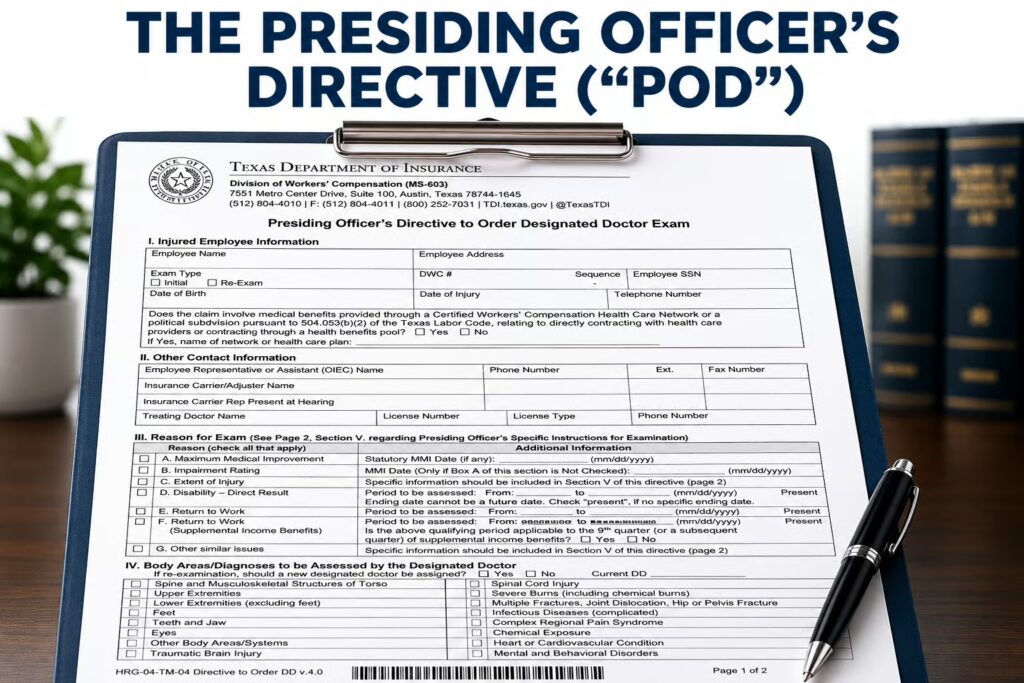
What is a POD, what to do with the POD, and how to best utilize the POD.
DWC states the POD and Letters of Clarification (LOC) are ways of communicating with designated doctors.
A POD is necessary when new information needs to be presented to the designated doctor, usually concerning extent of injury issues, and the designated doctor is asked to consider new information that was not previously available at the time of the designated doctor’s appointment. New information, such as extent of injury issues, posed to the designated doctor will necessitate a new examination by the designated doctor, which is a billable action for the designated doctor.
An LOC is necessary when a clarification or correction is needed from a designated doctor regarding questions that have arisen from the designated doctor’s report. The LOC does not result in another examination by the designated doctor. The LOC response from the designated doctor is not a billable action for the designated doctor. Thus, LOCs should be used sparingly and only in specific instances.
When Are PODs Necessary?
PODs are a DWC creation and are necessary when:
- Administrative Law Judges (ALJs) need specific reports from a designated doctor in order to resolve a dispute;
- There is a need for an opinion from the designated doctor in order to reduce delays in a dispute; or
- There is a need to end or stop a dispute within a dispute.
The authority of DWC for the creation of PODs is derived from Texas Labor Code Section 408.0041. Subsection (d) addresses situations where any division staff member may contact the designated doctor to avoid “undue influence” on the designated doctor. Subsection (a) advises on the request of the insurance carrier or claimant, or DWC’s own order, DWC may order a designated doctor examination to resolve any question about a variety of issues, including extent of injury, as outlined in Labor Code Section 408.0041(a)(1-6).
Disputing the Issuance of a POD
Disputing the issuance of a POD is allowed by DWC according to Rule 127.1.
When to dispute the issuance of a POD:
- When a 90-day issue is present regarding the finality of the initial impairment rating issued in the case;
- Scheduling of the designated doctor examination is premature or sufficient time has not elapsed between designated doctor examinations;
- Unresolved disputes as to compensability remain;
- The request for a POD lacks any factual or legal basis to support approval.
NOTE: Often PODs are issued by BRO1s, who are DWC staff personnel assigned to the claim prior to a BRC being held. The BRO1 may not be familiar with the case or the specific or unique facts of the case. Hence, issuance of the POD by a BRO1 should be closely examined to ensure the POD is properly issued, and the information contained in the POD is factually correct (i.e., the accepted compensable conditions of the Carrier are correctly delineated, as well as the disputed condition/diagnosis pursued by the Claimant are correctly listed). Disputes as to the issuance of a POD must be addressed by the presiding officer who issued the POD.
The Goal of a Properly Issued POD
The goal of a properly issued POD is to achieve alternate certifications of MMI/IR, when there are extent of injury disputes pending.
For example, the Carrier may have only accepted sprain/strain injuries to the lumbar/cervical spine and received a certification from a designated doctor for the sprain/strain injuries. Claimant disputes the MMI/IR certification of the designated doctor and adds extent of injury issues concerning lumbar/cervical pathology/diagnosis/conditions.
A POD should be issued requesting the designated doctor to make a determination on the extent of injury diagnoses/conditions, and then request the designated doctor to offer three alternate certifications of MMI/IR for:
- The accepted conditions of the Carrier,
- Injuries claimed by the Claimant, and
- The designated doctor’s interpretation of what the compensable injury should be, which is his determination of the disputed extent of injury conditions/diagnoses.
NOTE: The POD may only request two alternate certifications from the designated doctor, if the designated doctor had previously only rated the accepted compensable conditions of the Carrier. Additionally, some PODs will ask for alternate certifications for the Carrier’s accepted conditions, all accepted and disputed conditions, and the designated doctor’s certification of his/her interpretation of the injury.
Reviewing the POD Carefully
The POD should be closely examined by the adjuster/Carrier’s attorney, to ensure all accepted and disputed conditions are accurately listed. The POD can be confusing if multiple extent of injury conditions/diagnoses are present.
For example, I have had cases where there are over 25 disputed extent conditions/diagnoses to be determined by the designated doctor, and over 50-plus accepted conditions of the Carrier.
Remember, the goal of the POD is to achieve an adoptable certification by the designated doctor depending on the extent of injury disputes.
The designated doctor may include only some of the disputed extent of injury conditions/diagnoses in his certification of MMI/IR, but should include all the accepted conditions of the Carrier. The designated doctor’s determination on extent of injury and his interpretation of what the compensable injury is, as well as his MMI/IR certification, will carry presumptive weight as the designated doctor was appointed on these issues.
If the designated doctor includes only some of the disputed extent conditions, as well as all accepted conditions of the Carrier, there may be an avenue to compromise the extent/MMI/IR issues. If a compromise cannot be reached between the parties, then the Carrier will have an adoptable certification of MMI/IR for the accepted conditions/diagnoses of the Carrier to utilize at the CCH.
Why Is the Designated Doctor Offering Three DWC-69s?
The question often arises as to why a designated doctor is offering three DWC-69s in a case.
The designated doctor is issuing separate DWC-69s for each alternate certification of MMI/IR that he is requested to give. The DWC-69s of the designated doctor should be consistent with the requested alternate certifications of MMI/IR that have been requested by the BRO1 or BRO2.
Designated Doctor Alternate Certifications: Which DWC-69 Controls?
A second question that often arises is which specific DWC-69 given by the designated doctor matches the requested alternate certification of MMI/IR.
Usually, a designated doctor will label each DWC-69 he is being requested to give at the top of the form. For example, a designated doctor should label the DWC-69 for all Carrier-accepted conditions as a DWC-69 for “Carrier-accepted conditions.”
The DWC-69 given by the designated doctor for the requested alternate certification of all disputed extent conditions and Carrier-accepted conditions should also be labeled as such at the top of the DWC-69.
Finally, the DWC-69 offered by the designated doctor for his interpretation of the injury should be labeled at the top of the DWC-69 as “designated doctor’s determination of extent of injury” or “designated doctor’s determination of extent conditions.”
Please note: There are occasions where a designated doctor fails to label or identify the individual DWC-69s with the requested alternate certification of MMI/IR. In these instances, the designated doctor’s report must be referenced and, hopefully, the designated doctor’s report will make it clear which DWC-69 is offered for the requested alternate certification of MMI/IR.
Further note: There are occasions where the designated doctor does not label the DWC-69 given as to which alternate certification of MMI/IR it pertains to, and even instances where the designated doctor fails to clarify in his report which DWC-69 coincides with the requested alternate certification. In these instances, an LOC should be requested by the Carrier to the BRO1 or BRO2 seeking clarification from the designated doctor.
Remember
Usually, the most important alternate certification offered by the designated doctor is the designated doctor’s interpretation of the injury and determination of the disputed extent of injury conditions at issue. This DWC-69 will usually carry presumptive weight and is the alternate certification that must be acted upon by the Carrier.
DWC-32 vs. the POD
There are occasions where the Carrier or Claimant files a DWC-32 seeking extent of injury determinations by a designated doctor after the designated doctor has already examined the claimant for purposes of MMI/IR, but prior to a POD being issued.
The question arises as to whether the DWC-32 requesting a designated doctor appointment should be acted upon without the issuance of a POD.
Of course, this is a case-by-case determination, but if extent of injury conditions/diagnoses are being added by the Claimant, or Carrier, after the initial designated doctor appointment, then likely a POD should be requested by the Carrier or Claimant.
The goal of the Carrier is to receive alternate certifications of MMI/IR from the designated doctor given extent of injury disputes have arisen after the initial designated doctor examination.
A DWC-32 filed by either party on extent of injury, even if MMI/IR issues are added, will not guarantee the designated doctor gives alternate certifications of MMI/IR.
Indeed, the designated doctor may treat a DWC-32 requesting extent of injury, MMI, IR as an examination where only one certification of MMI/IR would be given.
The designated doctor may determine that some extent of injury conditions/diagnoses are added to the injury which would in effect knock out or cancel the designated doctor’s initial MMI/IR certification on Carrier’s accepted compensable injury.
In this instance, the Carrier would not have an adoptable certification of MMI/IR given the designated doctor’s most recent report.
If there are questions regarding whether a DWC-32 adding extent of injury following a designated doctor examination on MMI/IR should be issued or a POD would be a better tool used by the Carrier, it is wise to consult with one of the D&S attorneys to make such determination.
I have had cases where a designated doctor’s certification of MMI/IR for the Carrier’s accepted conditions became invalid based on a subsequent examination by the designated doctor on extent of injury because a designated doctor was not asked for alternate certifications of MMI/IR.
Additionally, I have often encountered situations at a BRC when the Presiding Benefit Review Officer stated a POD would not be issued because a DWC-32 had already been filed in the case requesting extent of injury be addressed as an issue.
In such instances, I usually press for a POD to be issued to allow alternate certifications of MMI/IR be given by the designated doctor.
The request to the BRO may have to be forcefully asserted because there may be occasions where some BROs want to avoid the additional work of issuing a POD in the case and would prefer the DWC-32 be filed by the parties. But if the POD is preferable, then a push for a POD should be made. Be aware of the reluctance of some BROs in not wanting to issue PODs.
Practice Points
PODs may not always be sent to the handling Carrier attorney who appeared at the BRC.
This is because even though the BRO may be in charge of drafting the POD, the POD will usually be issued by other DWC personnel which will only forward the POD to the Carrier’s DWC mailbox.
As such, the POD may or may not be sent to the Carrier’s attorney present at the BRC.
So, upon receipt of a POD in a case, please forward to the D&S attorney handling the case.
The POD may notify the Carrier that a new designated doctor is being appointed in the case.
The handling attorney who receives the POD will then verify that a new designated doctor should be appointed or alternatively identify that a designated doctor listed on the POD is still qualified or on the designated doctor list.
As such, there are several reasons why receipt of a POD should be handled in an expedited manner and sent to the handling attorney at the earliest available time.
Misapplication of PODs by ALJs
Be aware recently there have been misapplications of PODs by certain ALJs post CCH.
For example, I have received PODs from ALJs following the CCH held on MMI/IR/extent of injury issues.
A proper POD from an ALJ following a CCH on MMI/IR/extent of injury should properly identify which extent of injury conditions have been determined by the ALJ and ask for a certification of MMI/IR consistent with the ALJ’s determination of extent of injury.
This is a common practice by ALJs following a Contested Case Hearing on extent/MMI/IR.
However, recently I have received some PODs which ask the designated doctor to provide alternate certifications of MMI/IR consistent with different scenarios of extent of the injury.
For example, the ALJ asks for alternate certifications of MMI/IR if extent of injury is determined to include some conditions but not other conditions.
In such instance, it appears the ALJ is requesting alternate certifications from the designated doctor and after receipt of the alternate certification will then decide what extent of injury conditions/diagnoses are compensable.
In my opinion, this is an improper use of a POD and indicates that an ALJ will likely be influenced by what the designated doctor determines what the impairment rating will be based on the various extent scenarios he is presented with.
In a strong sense, the ALJ seems to be “fishing” for the designated doctor to provide alternate certifications of MMI/IR and may be inclined to accept the higher impairment rating, then decide how he will determine disputed extent conditions/diagnoses.
The alternate certifications of MMI/IR by a designated doctor should not be a reason as to how an ALJ determines extent of injury disputes.
Again, the proper procedure should be the ALJ informs the designated doctor of his decision on extent of injury and then requests corresponding alternate certifications of MMI/IR consistent with the ALJ’s determination of extent. Not the other way around where an ALJ decides extent of injury after receiving alternate certifications of MMI/IR from the DD.
Conclusion
The POD is a vehicle created by DWC to help resolve extent of injury disputes and to provide adoptable certifications of MMI/IR given the parties’ positions regarding extent of injury.
The POD is a valuable tool to use to help either resolve a case or to facilitate resolution of the disputes and provide an ALJ with a vehicle to help decide disputed issues in the case.
Author: Charles E. Morse

Our Attorneys at Downs & Stanford, P.C. remain focused on helping you manage risk, control costs, and navigate claims with confidence.
Send your questions to Q&A.
For Employer’s Liability, General Liability, Subro, and all other areas of law, email questions here.
Want some CE credit? Come and get it! Join us for Lunch and Learns every second Friday of the month. For information and registration, email CE Department.
Have questions about Designated Doctors, RMEs, or Peer Reviews or have records for a DD, RME, or Peer? Email our DD Department.